

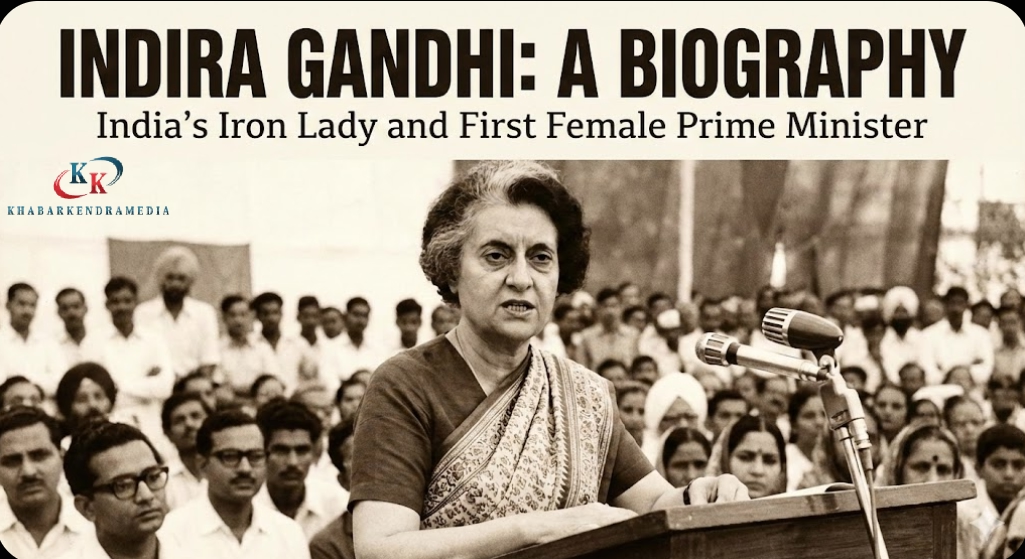
Indira Gandhi is still one of the most charismatic and contentious personalities of contemporary Indian history. From the high-profile sphere of the Nehru family, she went on to be the only woman Prime Minister of India and held the office for two terms (1966-77 and 1980-84) before a bloody assassination ended her reign in 1984. Now and then dubbed the “Iron Lady of India,” Gandhi guided one of the world’s most populous nations through wars, economic reforms, and anti-Sikh violence with a mix of forceful leadership and authoritarianism.
What she did, like her Green Revolution and the 1971 war that led to the creation of Bangladesh, made her a darling among many even as her Emergency period brought blistering criticism. This biography traces her life from a childhood in active politics to becoming one of the key members of the Congress Party and aims as much to paint her palmate leaves as it does its single blossom bursts.
| Attribute | Details |
|---|---|
| Full Name | Indira Priyadarshini Gandhi (née Nehru) |
| Date of Birth | 19 November 1917 |
| Place of Birth | Allahabad (now Prayagraj), Uttar Pradesh, India |
| Date of Death | 31 October 1984 |
| Political Party | Indian National Congress |
| Father | Jawaharlal Nehru |
| Spouse | Feroze Gandhi (m. 1942; d. 1960) |
| Children | Rajiv Gandhi, Sanjay Gandhi |
| Education | Somerville College, Oxford (did not graduate); various schools in India, Switzerland, and England |
Early Life and Education
Indira Gandhi was born on 19 November 1917 in Allahabad to her father Jawaharlal Nehru and mother, Kamala Nehru. She grew up in the Anand Bhawan, a centre of nationalist activities, at a time when the freedom movement had taken root all over India. Her father and grandfather were leading figures in the struggle for independence along with Mahatma Gandhi. A solitary childhood with her father perennially in prison and a mother who was sick made her tough.
She was educated in India (at Visva-Bharati University, Shantiniketan) as well as in Switzerland (Ecole Internationale, Geneva) and England (Badminton School, Bristol, and Somerville College, Oxford). Although she never finished her studies because of health reasons, her education influenced the way she thought. As a girl, she founded the ‘Vanar Sena,’ a children’s organization in support of the independence movement.
Political Career Journey
Indira Gandhi began informally in politics as her father’s hostess and confidante after India won independence in 1947. She was elected to the Congress Working Committee in 1955 and became party president in 1959. After the deaths of Jawaharlal Nehru in 1964 and Lal Bahadur Shastri in 1966, she was appointed Prime Minister, initially perceived as a “puppet” but quickly establishing her authority.
During her first term (1966–1977), she enacted many official policies with the slogan of “Garibi Hatao” (Remove Poverty). persecute two major researches one among At heights of popularity, Indira Gandhi suffered a humiliating defeat at the hands of than in 18 years, on an impulse decided to poll pettiness. Dissent and strikes in the service and other industries led to Prime Minister Indira Gandhi”s imposition of The Emergency (1975-1977), which lasted 21 months.
Defeated in 1977, she came back to victory in 1980. Her second term, from 1980 to 1984, was dominated by political instability and opposition politics, economic problems, and Punjab insurgency.
Political Timeline Table
| Year | Event | Details |
|---|---|---|
| 1917 | Birth | Born in Allahabad to Jawaharlal and Kamala Nehru |
| 1942 | Marriage | Married Feroze Gandhi |
| 1959 | Congress President | Elected president of Indian National Congress |
| 1964 | Entered Cabinet | Minister of Information and Broadcasting under Shastri |
| 1966 | Became Prime Minister | First term begins after Shastri’s death |
| 1971 | Indo-Pak War | Victory leading to creation of Bangladesh |
| 1975 | Emergency Declared | State of Emergency imposed until 1977 |
| 1977 | Election Defeat | Congress loses power |
| 1980 | Return as Prime Minister | Wins election and begins second term |
| 1984 | Assassination | Killed by her bodyguards on 31 October |
Controversies
There were also major controversies in Indira Gandhi’s career. The 1975–1977 Emergency, in which its prime minister used repression to preserve his power (censorship of the press, forced sterilisations, mass arrests of opposition party members), is considered a dark period for the general strike. The influence of her son Sanjay at this time led to allegations of nepotism.
” Operation Blue Star in 1984, an effort to clear the Golden Temple of Sikh militants left hundreds dead and the shrine scarred, alienating Sikhs. This indirectly results to her assassination by her Sikh body guards. Bank nationalisation and doing away of privy purses for former royals had previously stirred discussions on socialism versus democracy.
Personal Life
She wed Feroze Gandhi in 1942 over family objections to their religious difference. They had two sons: Rajiv (1944–1991) and Sanjay (1946–1980). Feroze died in 1960, and Sanjay in a 1980 plane crash. Following Sanjay’s death, Indira Gandhi encouraged her other son, Rajiv, to enter politics despite his reluctance. Her disciplined habits and love of nature allowed her to have a normal family life while living in the public eye.
Read Also: Mamata Banerjee Biography: The Iron Lady of West Bengal
Legacy and Assassination
Indira Gandhi was assassinated at her residence in New Delhi on 31 October 1984 by two of her bodyguards as an act of vengeance for Operation Blue Star. Her murder led to anti-Sikh riots, in which thousands were killed. Her son Rajiv Gandhi followed her.
Gandhi’s legacy is a mixed one: he is appreciated for empowering Indian sovereignty, agricultural self-reliance and global standing but has been accused of consolidating power. She was awarded the Bharat Ratna in 1971 and voted “Woman of the Millennium” in a BBC poll.
Frequently Asked Questions
Who was Indira Gandhi?
India was led by a woman for the first time in its long history as a nation when Indira Gandhi became India’s third Prime Minister.
What were her major achievements?
Key achievements are the Green Revolution, bank nationalisation and the victory in 1971 war, which led to the formation of Bangladesh.
Why was the Emergency declared?
Charged with that political opposition and a court judgment against her election in 1975, she declared a state of Emergency to stay in power.
How did Indira Gandhi die?
She was then assassinated on 31 October, 1984 by her Sikh bodyguards.
Who was her father?
Jawaharlal Nehru the first Prime Minister of India.
What is her lasting legacy?
She was the face of strong leadership who changed the economy and foreign policy of India, though the Emergency continues to divide opinion about her.
The life of Indira Gandhi reflects the soaring and sinking of power in a vibrant democracy. Her daring left its mark on modern India, from food security to international assertiveness. Even many years after her death, discussion and appreciation live on. Continue to be informed about the political history of India for better understanding of leaders like her.

